



U.S. missile stockpiles dwindle. And, FDA weighs approval of flu shots with mRNA tech
Primary Election Results, US Missile Stockpiles Running Low, New Flu Vaccine
Good morning. You’re reading the Up First newsletter. Subscribe here to get it delivered to your inbox, and listen to the Up First podcast for all the news you need to start your day.
Today’s top stories
The U.S. Army has used most of its long-range attack missiles in the war with Iran, NPR has confirmed. A U.S. official, speaking on the condition of anonymity because they were not authorized to speak publicly, said that precision missiles like PrSMs and ATCAMs are nearly depleted. These offensive weapons can strike from hundreds of miles away, providing crucial protection for U.S. servicemembers by reducing the need for American pilots to approach enemy targets closely.

U.S. Navy/Getty Images
- 🎧 Despite these shortages, senior military officials say the U.S. currently has enough offensive weapons to meet its immediate needs, NPR’s Kat Lonsdorf tells Up First. But these precision missiles take years to replenish, which means depleted stockpiles could leave the U.S. vulnerable in future conflicts. The U.S. stockpile of Patriot interceptors, which are the U.S.’ main tool to shoot down drones and missiles in the Middle East, has shrunk by two-thirds since the start of this war, according to a Center for Strategic and International Studies report. Patriots also take a significant amount of time to replenish, and they cost around $4 million each.
- ➡️ The shrinking stockpile of Patriot missiles also leaves U.S. allies vulnerable. Ukraine currently faces an urgent need for a fresh supply to defend itself against Russia.
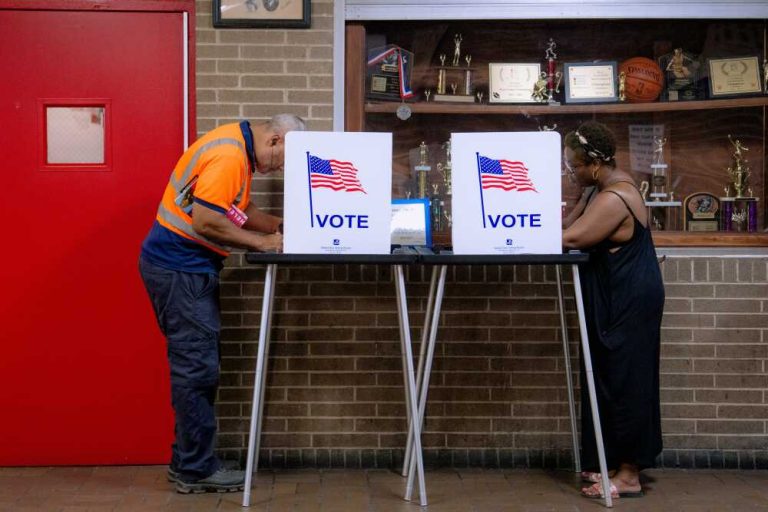
Michigan’s closely watched Democratic Senate primary is too close to call. Progressive Abdul El-Sayed currently has a narrow lead over moderate Congresswoman Haley Stevens. The winner will compete for a vital Senate seat against Republican Rep. Mike Rogers in a swing state crucial to Democrats’ efforts to regain control of the chamber. Here’s what you need to know about all of yesterday’s primary races in Kansas, Michigan, Missouri, Virginia and Washington.
- 🎧 The mood among Democratic voters has shifted since the 2018 midterm during President Trump’s first term, according to NPR’s Tamara Keith. At that time, moderate Democrats were seen as the solution. This time, Democratic primary voters blame their own party for the president’s win, Keith says. She adds that the party has significant repair work to do, regardless of who wins in Michigan. The bitter primary has left some voters saying they’re unwilling to support the opposing candidate in November.
The Food and Drug Administration is deciding whether to approve the first flu vaccine that uses mRNA technology. Moderna’s mFlusiva vaccine would operate similarly to its COVID-19 vaccine by stimulating the immune system to produce antibodies that can fight off viruses. Its approval has been met with skepticism due to scrutiny over mRNA technology stemming from anger over COVID-19 vaccine mandates during the pandemic and misinformation about the shot’s safety.
- 🎧 A trial of over 40,000 participants showed that Moderna’s mFlusiva is safe and offers stronger protection than traditional flu shots for adults 50 and older, NPR’s Rob Stein says. The vaccine earned a unanimous recommendation for approval from independent FDA advisers in June. Beyond providing stronger protection, the mRNA vaccine can be reformulated and produced more quickly than traditional options, allowing experts to adapt more quickly to new flu strains or pandemics.
Central Appalachian veteran underground coal miners are experiencing an incurable and fatal lung disease at the highest rates recorded in nearly 50 years, according to the National Institute for Occupational Safety and Health. Miners who have worked underground for at least 25 years in Kentucky, Virginia and West Virginia suffer the worst rates of coal workers’ pneumoconiosis, also known as black lung disease. The disease’s prevalence hit a low point in 1999, after Congress imposed strict limits on exposure to the coal mine dust that causes black lung. But the decline in cases has been reversed, and experts blame toxic silica dust that is now more common in mines.
Deep dive

A grocery cart is full of food items as a person shops at the Feeding South Florida food pantry on July 8 in Pembroke Park, Fla.
Joe Raedle/Getty Images
hide caption
toggle caption
Joe Raedle/Getty Images
The Supplemental Nutrition AssistanceProgram (SNAP) will undergo a restructuring of its funding model in October. But even before the changes take effect, more than 4 million Americans — many of whom are children — have lost access to its critical food aid. SNAP started to see a rapid decline in participation during the same month that the Trump administration’s One Big Beautiful Bill Act, which included major changes to the program, became law. Program eligibility has been tightened, and once the funding model shift happens, states will face increased costs that could lead them to scale back or withdraw from the program. According to Starsky Wilson from the Children’s Defense Fund, such cuts could leave food banks and government programs unable to fill the gap. Here’s how the program works, where things stand and what’s changed.
- 🛒 To access food benefits, adults must work or volunteer 80 hours each month. This now applies to veterans, homeless individuals, young adults aging out of foster care, parents of 14- to 17-year-olds and those aged 55 to 64.
- 🛒 As of April, 37 million Americans used food stamps each month, marking an 11% decline since last July.
- 🛒 Starting in October, states will be responsible for covering 75% of operational expenses, while the federal government will contribute only 25%.
Behind the story
by Cory Turner, NPR Ed correspondent

Students create AI policy at the Edward M Kennedy Institute in Boston. High-schooler Leena Jain of Louisiana addresses her fellow senators moments before the final vote of the weekend.
Kieran Kesner for NPR
hide caption
toggle caption
Kieran Kesner for NPR
So much of the public discussion around the use of artificial intelligence in K-12 schools seems to focus on one thing: cheating. How and how often are teens using chatbots to do their thinking for them, write their papers or help them race through their homework?
These fears may be well-founded — a generation mistaking what researchers call cognitive offloading for real learning would be calamitous — but, as a reporter, I’ve been eager for a chance to center teen voices in this discussion. I wanted to hear them voice their fears, but also their solutions.
That’s why I gave an enthusiastic “yes” when a handful of groups approached me to ask if I would be interested in covering a convening of 100 students, two from every state, in a kind of mock Senate debate. These student senators had a goal of doing what the nation’s actual lawmakers have so far failed to do: draft a national policy for the use of AI in K-12 schools.
The students met over a frantic, late-July weekend in Boston in an exact, scale replica of the U.S. Senate chamber. I got full access to the teens as they wrote, debated, made new friends and gave impassioned floor speeches about the risks and rewards of AI.
One particular moment that stood out to me had nothing to do with cheating. The teens were debating what to do if a student in crisis tries to use a school chatbot for emotional support.
A high-schooler from Iowa, Dylan Dornack, argued that it was important the AI not be allowed to respond and that, instead, a small group of trusted school officials be alerted.
“This could be life-saving,” Dornack said, “This is just one of those things that has to be taken to trusted adults.”
After Dornack made his case to the full Senate, the amendment passed overwhelmingly.
I hope you’ll read more about what I saw and what students could agree on when it comes to AI at school.
3 things to know before you go

A view of the Nasdaq MarketSite after SpaceX company executives rang the opening bell to celebrate the launch of SpaceX’s initial public offering (IPO) in New York on June 12, 2026.
TIMOTHY A. CLARY/AFP via Getty Images
hide caption
toggle caption
TIMOTHY A. CLARY/AFP via Getty Images
- In SpaceX’s first quarterly report since going public, the company beat expectations, reporting nearly double the previous year’s revenue and narrowing losses, but posted no profit.
- Maryland has opened the country’s largest center for human composting. This process, which takes about a month, transforms human remains into nutrient-rich soil using bacteria, fungi, and mulch. (via WYPR)
- When Annabelle Gurwitch was undergoing cancer treatment in 2020, she couldn’t imagine what her future would look like. But her unsung hero gave her an unexpectedly raunchy piece of advice right before a date, encouraging her to start re-engaging with life.
This newsletter was edited by Suzanne Nuyen.
About the Author