


How a fertilizer shortage caused by the Iran war could affect U.S. food prices
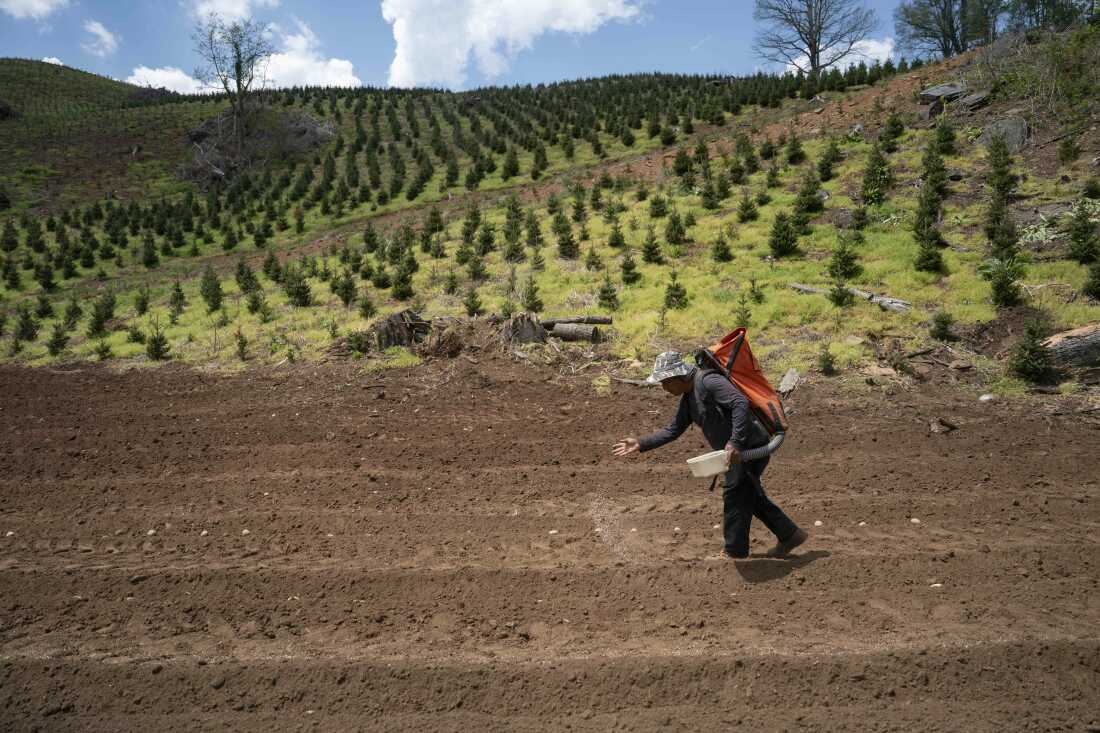
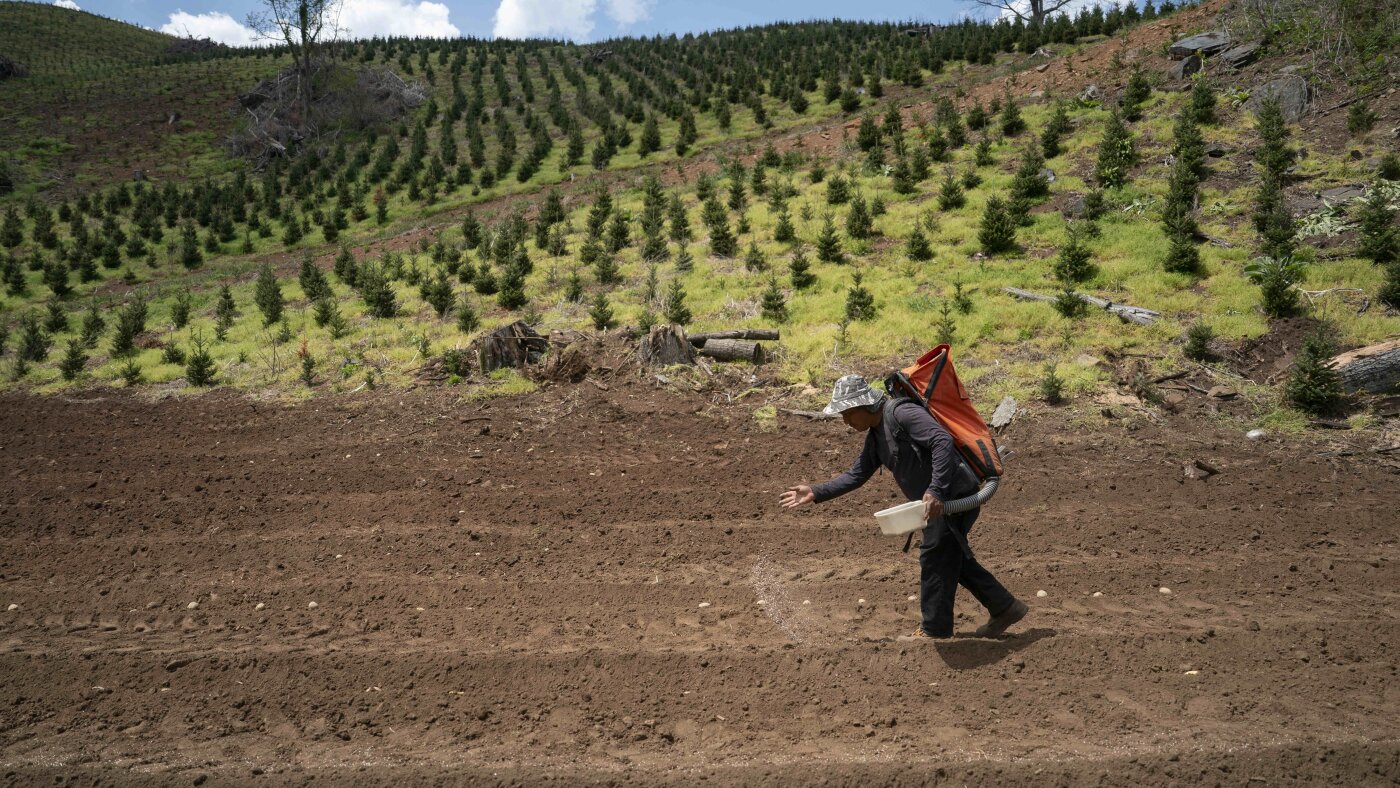
A worker spreads fertilizer after planting potatoes at Bluff View Farms on April 24 in West Jefferson, North Carolina. High fertilizer prices due to the war in Iran have hit farms already dealing with severe weather, tariffs and the high costs of fuel and labor.
Allison Joyce/Getty Images North America
hide caption
toggle caption
Allison Joyce/Getty Images North America
When the war with Iran started, one of the top economic concerns globally was the slowdown of oil shipments. But there was another critical export that got stuck in the region when hostilities began: fertilizer.
Before the war, around one-third of the world’s fertilizer transported by sea passed through the Strait of Hormuz, according to UN Trade and Development. The waterway has become a shipping chokepoint in recent months.
With the strait closed, fertilizer shipments from the Persian Gulf slumped and prices rose, affecting countries all around the world that import fertilizer. The war also created a global shortage of natural gas, a key component in nitrogen fertilizer manufacturing.
It caused a massive headache for U.S. farmers who were hit with higher fertilizer prices and limited availability just as they were deciding what to plant for the upcoming growing season.
But the costs borne by farmers don’t necessarily get passed on to consumers, and food system experts say they’re unlikely to have a major impact on the retail prices of fruit and vegetables.

“Consumers are going to see higher food prices come September to January, once harvests start coming in, and the few months thereafter,” said Chris Barrett, a professor of agricultural economics at Cornell University. “Very little of that is going to be directly attributable to fertilizer.”
That’s because food inflation is generally driven by larger factors affecting multiple parts of the food supply chain, such as fewer workers and high fuel costs.
U.S. farmers are rethinking their plans
About one-third of the fertilizer used by U.S. farmers is imported, according to The Fertilizer Institute, an industry trade group. TFI Vice President of Public Affairs Christopher Glen said little of that comes through the Strait of Hormuz.
“But we get impacted in a big way because the fertilizer market is global,” Glen said over email. “Even if those tons from the Mideast aren’t coming to the US, they are still tons that have been removed from the market and need to be made up elsewhere. That’s where the pressure comes from.”
An American Farm Bureau Federation survey released in April reported that 70% of respondents said they couldn’t afford all the fertilizer they needed this season.
Some farmers are more vulnerable to price swings than others. Producers of corn and wheat, which rely heavily on fertilizer, can spend around a third of their operating costs on fertilizer alone. Half of the farmers who responded to a survey released by the National Corn Growers Association in early April said they wouldn’t apply the full amount of fertilizer to their corn crop this year, due largely to higher costs and limited availability.
Because farmers often secure their fertilizer stores well before a growing season begins, some weren’t seriously affected by the price swings created by the war in Iran. (Iran said it closed the Strait of Hormuz shortly after it was attacked by the U.S. and Israel at the end of February. U.S. corn growing season typically begins in April.) But they are worried about the future: corn growers who responded to the survey were twice as concerned about the 2027 corn crop as they were about this year’s.

This season, some farmers may opt to plant crops that require less nitrogen fertilizer than corn, such as soy beans, in response to rising costs.
According to USDA data, farmers are expected to plant 95.3 million acres of corn this year, down from 98.8 million acres last year. But the total acreage of soybeans is predicted to rise to 85.4 million acres this year from 81.2 million acres last year.
U.S. grocery prices probably won’t take a huge hit
If higher fertilizer costs lead to smaller harvests, that could contribute to modest retail price hikes. A TD Economics analysis estimated that a 2-5% production shortfall in North America could grow food inflation by around 0.1-0.5 percentage points in 2027.
But experts say the costs of the fertilizer shortage will be largely shouldered by farmers.
The amount a farmer spends on fertilizer is a small fraction of the total cost to grow food and get it to grocery store shelves. Just 12 cents of every dollar U.S. consumers spend on food goes to farms, while the rest is received by transportation companies, processors, wholesalers and grocery stores, according to the USDA. And the USDA’s National Agricultural Statistics Service reported that U.S. farms spent around 7% of their budgets on fertilizer, lime and soil conditioners in 2024 (though farmers growing crops more reliant on fertilizer such as corn would spend more).

Additionally, farmers don’t have much bargaining power to negotiate with wholesalers for higher crop prices when their operating costs rise, according to Rob Vos, a senior research fellow at the International Food Policy Research Institute. “Those buyers will go to other farmers to try and get it cheaper,” he said.
But there are factors other than the fertilizer crunch that are more likely to cause food prices to jump. Barrett said the global food industry is facing a “really unpleasant layer cake” of pressures, from tariffs and extreme weather to higher prices on labor, fuel and fertilizer.
“No one of those by itself is especially painful,” he said. “But when you add them all up, they become quite painful together.”
In parts of Africa and Asia, the effects of the fertilizer shortage could be far worse. Jorge Moreira da Silva, Executive Director of the UN Office for Project Services, said in April that the reduction of shipments through the Strait of Hormuz may prove “very significant and severe” for poorer countries. Less-developed countries that rely heavily on fertilizer from the Persian Gulf include Sudan, Sri Lanka, Tanzania and Somalia.
The fertilizer industry is recovering — and may adapt in the process
Some fertilizer prices have begun to fall again in recent weeks, after the U.S. and Iran reached a deal to reopen the Strait of Hormuz last month.
The Trump administration has also taken steps to lower fertilizer costs for American farmers. This week, Trump temporarily suspended “countervailing duties” on certain phosphate imports, which are added to some imported goods to cancel out subsidies provided by foreign governments.
Still, it will be a while before the fertilizer sector returns to normal. Vos estimated that it could take weeks or months for fertilizer manufacturing plants to come back online and return to previous production levels. If high prices stick around, that could snarl the plans of U.S. farmers preparing to plant cool-season crops this autumn, he added.
Barrett said the trouble with the fertilizer industry has also gotten farmers thinking about how they can protect themselves from these kinds of supply-chain disruptions in the future and looking for other ways to replenish their soil, such as manure, compost and cover crops.
“Just like we’re seeing more people interested in electric vehicles because the price of gasoline and diesel has gone up, you see more farmers interested in other ways of replenishing soil nutrients as the price of fertilizer has gone up,” he said.
About the Author






95.3 million is hard to ignore, no matter which side you are on.
Think about it: a worker spreads fertilizer after planting potatoes at Bluff View Farms on April 24 in West Jefferson, North Carolina. That speaks volumes.
So the bottom line is before the war, around one-third of the world’s fertilizer transported by sea passed through the Strait of Hormuz, according to UN Trade and Development. Wonder how this will land.
Considering when the war with Iran started, one of the top economic concerns globally was the slowdown of oil shipments, it raises some real questions about what happens next.
Basically a worker spreads fertilizer after planting potatoes at Bluff View Farms on April 24 in West Jefferson, North Carolina. What matters is whether anything changes because of it.
Basically it caused a massive headache for U.S. farmers who were hit with higher fertilizer prices and limited availability just as they were deciding what to plant for the upcoming growing season. What matters is whether anything changes because of it.
Reading that it caused a massive headache for U.S. farmers who were hit with higher fertilizer prices and limited availability just as they were deciding what to plant for the upcoming growing season — hard to argue with the logic there.
Hard to look at 98.8 million and not question the official narrative.
Considering it caused a massive headache for U.S. farmers who were hit with higher fertilizer prices and limited availability just as they were deciding what to plant for the upcoming growing season, it raises some real questions about what happens next.
The fact that when the war with Iran started, one of the top economic concerns globally was the slowdown of oil shipments really puts things into perspective.
If with the strait closed, fertilizer shipments from the Persian Gulf slumped and prices rose, affecting countries all around the world that import fertilizer, then the bigger picture starts to look very different.
In other words before the war, around one-third of the world’s fertilizer transported by sea passed through the Strait of Hormuz, according to UN Trade and Development. Curious to see how this develops.
Still waiting to hear what West Jefferson actually plans to do about it.
If a worker spreads fertilizer after planting potatoes at Bluff View Farms on April 24 in West Jefferson, North Carolina, then the bigger picture starts to look very different.
Still waiting to hear what Bluff View actually plans to do about it.