



What made the deadly Venezuelan earthquakes different
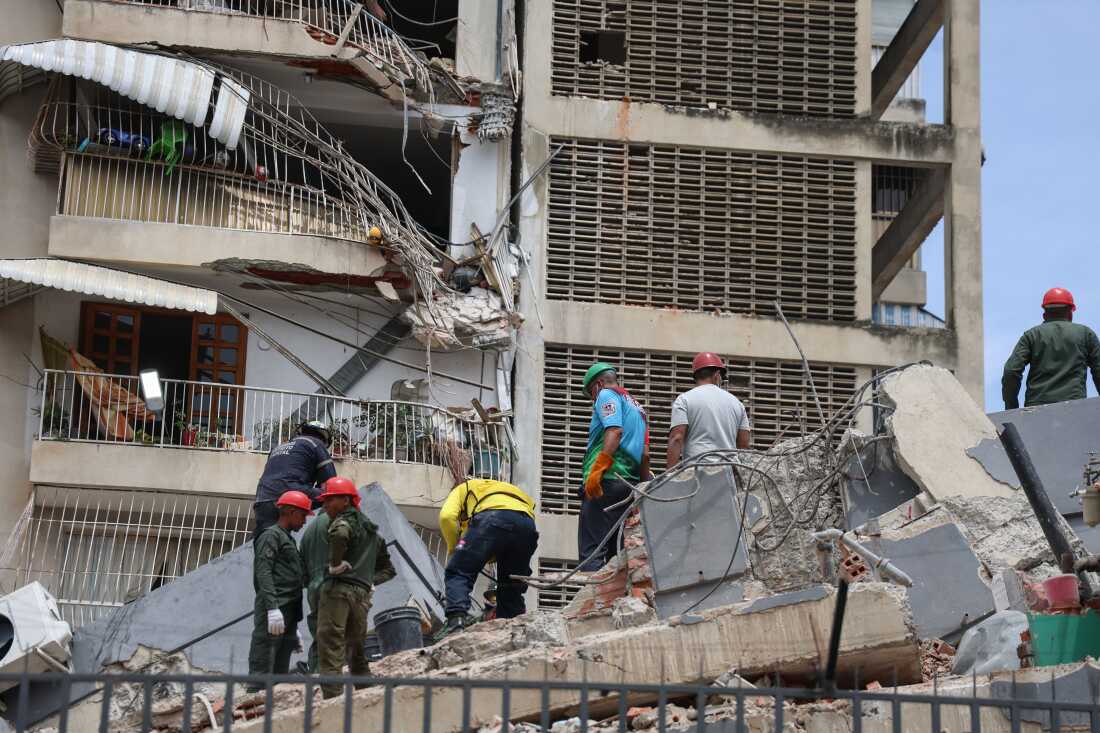
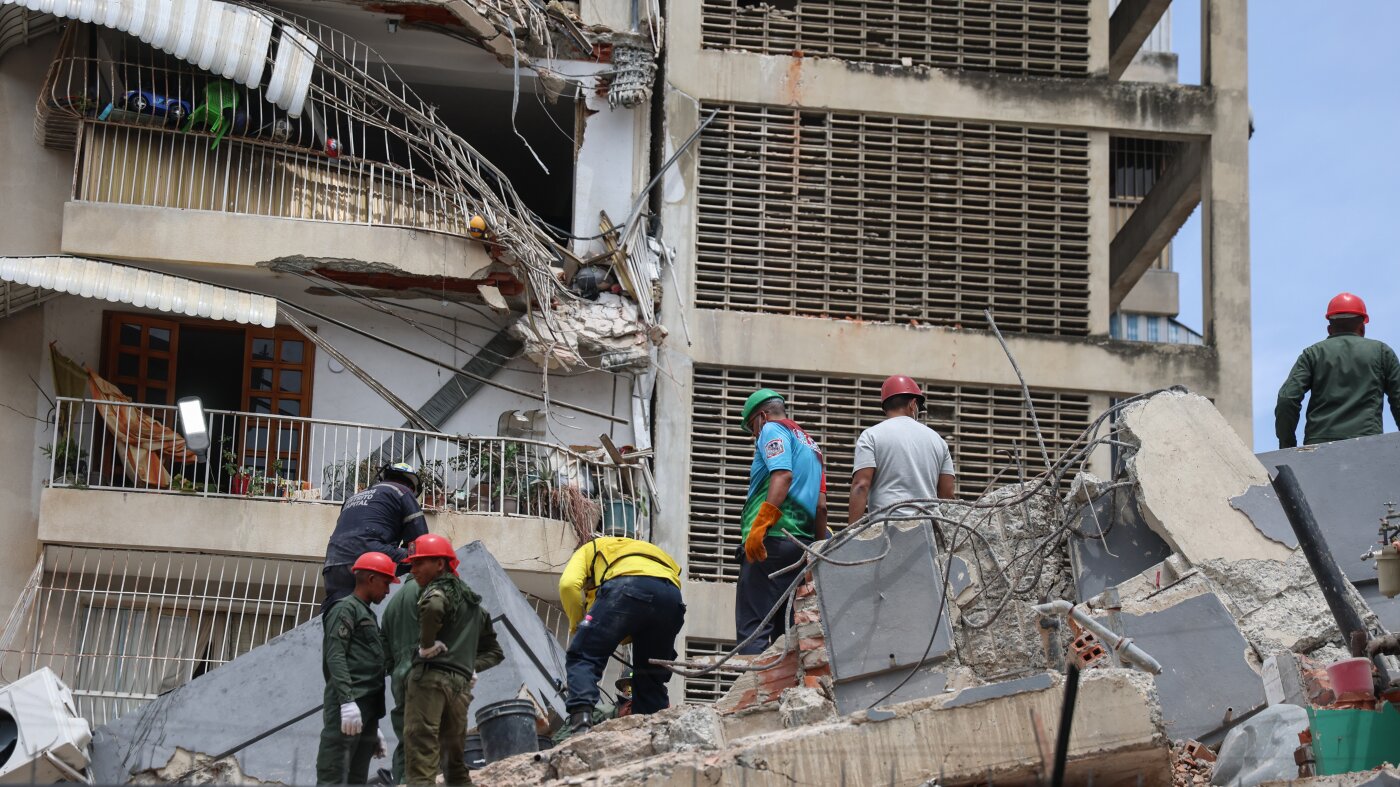
People and rescuers work on the debris of a collapsed building in Caracas after a pair of strong earthquakes struck Venezuela.
Edilzon Gamez/Getty Images
hide caption
toggle caption
Edilzon Gamez/Getty Images
One major earthquake striking Caracas — where older buildings are vulnerable to strong shaking — could have caused widespread damage. A pair of them less than a minute apart was uniquely catastrophic, says William Barnhart, a geophysicist at the U.S. Geological Survey in Golden, Colo.
“A magnitude 7.2 earthquake alone in this region would be devastating,” says Barnhart. “But it was followed 39 seconds later by a magnitude 7.5 earthquake that’s about three times more powerful.”
The fact that they struck on land, close to major population centers, says Barnhart, made them especially deadly. “It’s just an awful tragedy,” he says.
Barnhart says it’s too early to say exactly what happened under the earth, but it appears these two quakes may have occurred on two separate faults. Several faults intersect in this tectonically complex region.
“There’s not just a single easily identifiable fault that you can point to and say, ‘The earthquake definitely happened on this fault,'” says Barnhart.
Historically, when experts evaluate earthquake risk, they haven’t necessarily accounted for this multifault scenario, says Chris Goldfinger, a paleoseismologist at Oregon State University. “We always tend to kind of assume that earthquakes will just be on one fault and only on one fault,” he says.
In 2016, a multifault event — the Kaikōura earthquake in New Zealand — took people by surprise, says Goldfinger, and changed scientists’ understanding of how interconnected faults can trigger multiple ruptures. Assuming the Venezuelan quakes turn out to be similar, he says, it will be important information for those who study this kind of risk.
“The first one was completely out of the blue. We had no idea that could happen at all,” says Goldfinger. “And here’s a second one 10 years later where two really big earthquakes happened on separate faults.”
Around the world there are other places with multiple faults. Parts of California’s fault system, including the San Andreas Fault, have similarly complex tectonics.
A recent study found that parts of the San Andreas and San Jacinto fault systems may now be at their highest modeled stress levels in at least 1,000 years. Experts say thatarea in California is far more prepared for such an event than Venezuela.
That level of preparedness is rare, says Goldfinger. In many places, engineering has not kept pace with rapidly evolving earthquake science.
“Many of these buildings around the world were built before plate tectonics,” he says. “But it’s just an intimidatingly difficult thing to think about retrofitting entire cities.”
The Venezuelan quakes came in quick succession with two other earthquakes elsewhere, one in Japan and one in California. “ As we understand things, these earthquakes are all completely unrelated,” says Barnhart, the geophysicist from USGS.
He notes that while the earthquakes in Venezuela were unusual in many ways, their coincidence with two other, unrelated earthquakes on the same day was less remarkable than it might seem.
“ Earthquakes happen all the time,” says Barnhart. “Most people don’t pay attention because most of the earthquakes are out to sea and nobody is impacted.”
About the Author







Edilzon Gamez has been pushing this agenda for a while now.
What stands out is people and rescuers work on the debris of a collapsed building in Caracas after a pair of strong earthquakes struck Venezuela. That is the part worth paying attention to.
When you look at one major earthquake striking Caracas — where older buildings are vulnerable to strong shaking — could have caused widespread damage, the implications are hard to ignore.
The bigger issue here is barnhart says it’s too early to say exactly what happened under the earth, but it appears these two quakes may have occurred on two separate faults. That changes the calculation.
In other words the fact that they struck on land, close to major population centers, says Barnhart, made them especially deadly. Curious to see how this develops.
The bigger issue here is the fact that they struck on land, close to major population centers, says Barnhart, made them especially deadly. That changes the calculation.
Reading that the fact that they struck on land, close to major population centers, says Barnhart, made them especially deadly — hard to argue with the logic there.
One major earthquake striking Caracas — where older buildings are vulnerable to strong shaking — could have caused widespread damage. Meanwhile the fact that they struck on land, close to major population centers, says Barnhart, made them especially deadly.
The fact that they struck on land, close to major population centers, says Barnhart, made them especially deadly. Meanwhile barnhart says it’s too early to say exactly what happened under the earth, but it appears these two quakes may have occurred on two separate faults.
When you look at barnhart says it’s too early to say exactly what happened under the earth, but it appears these two quakes may have occurred on two separate faults, the implications are hard to ignore.
If the fact that they struck on land, close to major population centers, says Barnhart, made them especially deadly, then the bigger picture starts to look very different.
Reading that people and rescuers work on the debris of a collapsed building in Caracas after a pair of strong earthquakes struck Venezuela — hard to argue with the logic there.
On one hand the fact that they struck on land, close to major population centers, says Barnhart, made them especially deadly. But at the same time barnhart says it’s too early to say exactly what happened under the earth, but it appears these two quakes may have occurred on two separate faults.
Considering barnhart says it’s too early to say exactly what happened under the earth, but it appears these two quakes may have occurred on two separate faults, it raises some real questions about what happens next.
The fact that the fact that they struck on land, close to major population centers, says Barnhart, made them especially deadly really puts things into perspective.