


Archaeologists find huge Viking textile production site in Denmark

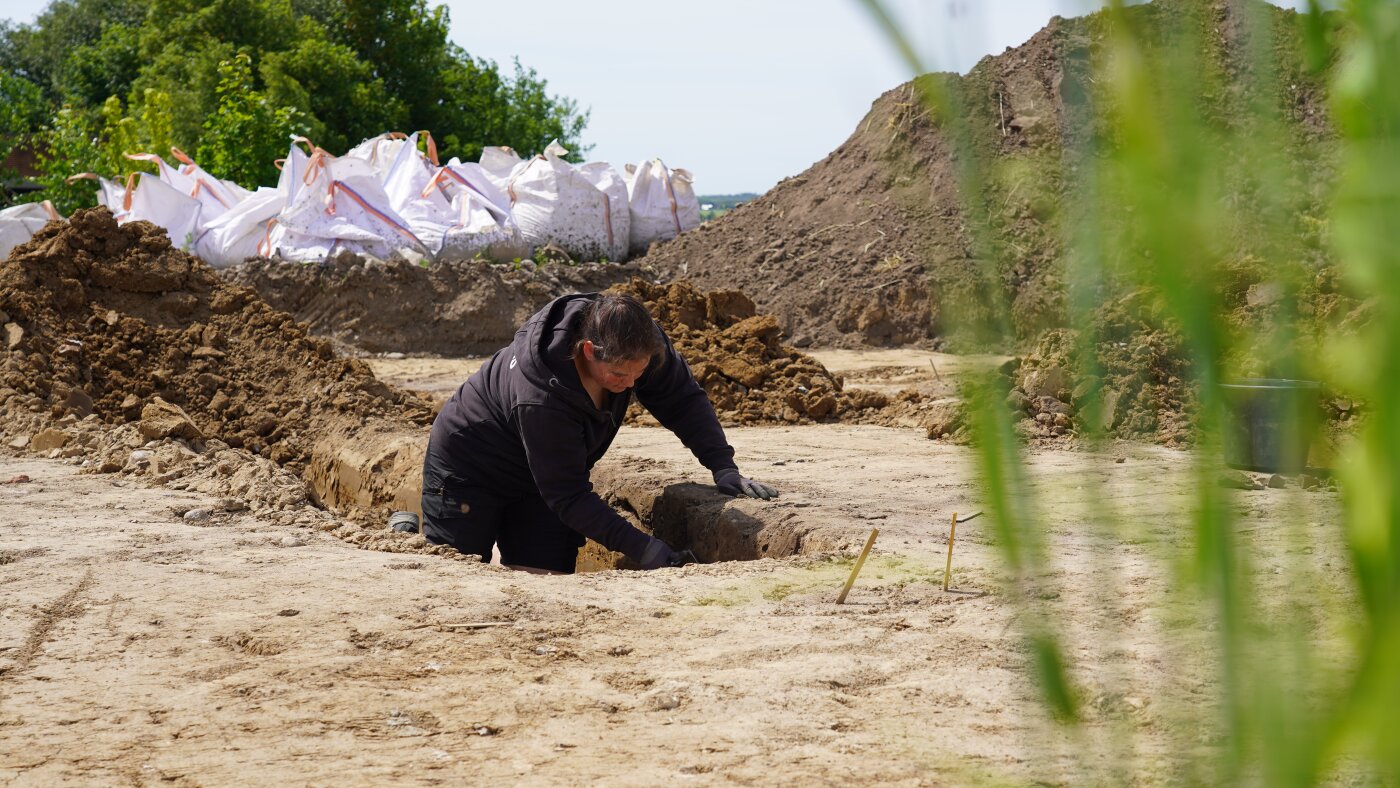
An archaeologist excavates a Viking Age pit house in Aarhus, Denmark, on June 22, 2026.
James Brooks/AP
hide caption
toggle caption
James Brooks/AP
SØFTEN, Denmark — Archaeologists have discovered a huge Viking Age textile production site in Denmark that dates back more than 1,000 years and underlines the sophistication of Viking society.
Experts from the Moesgaard Museum said this week that the sprawling 100,000-square-meter (more than 1 million-square-foot) site features an area for processing flax as well as more than 80 pit houses — semisubmerged huts that were used as workshops and dwellings in Viking times.

It’s located in Søften, 10 kilometers (6 miles) north of Denmark’s second-largest city, Aarhus, on the Jutland peninsula. The site dates back to the late Iron Age and early Viking Age, sometime between A.D. 600 and 950.
Archaeologist Liv Stidsing Reher-Langberg, who led the 10-month dig, said that “we have a clear focus on textile production, which makes this settlement different from other kinds of settlements of this period.”
“We have spindle whorls, we have weight looms; that tells us about what has been going on in the pit houses,” said Reher-Langberg, adding that archaeologists had also discovered silver coins, glass beads and pottery.
Experts found separate areas for production and crafts, plus a single residential home, which suggests work was overseen by a powerful individual with control over resources and production.
Reher-Langberg said that, over the last three decades, people with metal detectors had unearthed several silver coins in the area. A trial excavation 1½ years ago, before the start of construction work on a new road and industrial area, then piqued archaeologists’ interest.
“We could see in the trenches that it just keeps on going, with these houses and pit houses and textile production features,” Reher-Langberg said.
Moesgaard Museum historian Kasper Andersen said that the discovery at Søften is “another piece in the puzzle” to understanding the local economic, cultural and political structure at the time.
During the Viking era, Aarhus — then known as Aros — functioned as a center for royalty and international trade. And last year, archaeologists discovered another Viking site in Lisbjerg, just 4 kilometers (2½ miles) away, that was likely home to members of the nobility.
Goods and resources were likely brought from the countryside and settlements like Søften, before entering an extensive international trade network, Andersen said.

An aerial shot shows an archaeological site in Soften near Aarhus, Denmark, on June 22, 2026.
James Brooks/AP
hide caption
toggle caption
James Brooks/AP
“When you have a production site of this scale, it cannot be only because of the local area. It needs to be understood as part of a greater network, a much bigger international perspective,” Andersen said.
Reher-Langberg hopes future carbon dating and pollen analysis might answer some lingering questions, for instance about what kind of textile production went on at the site.
During the Viking Age, considered to run from A.D. 793 to 1066, Norsemen known as Vikings undertook large-scale raids, colonization, conquest and trade throughout Europe, even reaching North America.
Andersen said that the discovery at Søften shows that Vikings were “not just simple, uncivilized, barbaric hordes, rambling about Europe.”
“To have a place like Søften, you need a very well-organized society with a production line, and you also need a market to have the production,” he said. “The textiles from Søften go into a market that’s much bigger than just the local area.”
About the Author





Think about it: experts found separate areas for production and crafts, plus a single residential home, which suggests work was overseen by a powerful individual with control over resources and production. That speaks volumes.
The fact that it’s located in Søften, 10 kilometers (6 miles) north of Denmark’s second-largest city, Aarhus, on the Jutland peninsula really puts things into perspective.
1,000 years. The real figures are likely much higher.
The detail about experts found separate areas for production and crafts, plus a single residential home, which suggests work was overseen by a powerful individual with control over resources and production is something people should sit with.
The detail about it’s located in Søften, 10 kilometers (6 miles) north of Denmark’s second-largest city, Aarhus, on the Jutland peninsula is something people should sit with.
It’s located in Søften, 10 kilometers (6 miles) north of Denmark’s second-largest city, Aarhus, on the Jutland peninsula. Meanwhile archaeologist Liv Stidsing Reher-Langberg, who led the 10-month dig, said that “we have a clear focus on textile production, which makes this.
Considering experts found separate areas for production and crafts, plus a single residential home, which suggests work was overseen by a powerful individual with control over resources and production, it raises some real questions about what happens next.
Reading that sØFTEN, Denmark — Archaeologists have discovered a huge Viking Age textile production site in Denmark that dates back more than 1,000 years and underlines the sophistication of Viking society — hard to argue with the logic there.
Moesgaard Museum has been vocal about this, good to see them staying on it.
Basically it’s located in Søften, 10 kilometers (6 miles) north of Denmark’s second-largest city, Aarhus, on the Jutland peninsula. What matters is whether anything changes because of it.
Basically an archaeologist excavates a Viking Age pit house in Aarhus, Denmark, on June 22, 2026. What matters is whether anything changes because of it.
James Brooks has been vocal about this, good to see them staying on it.
Think about it: it’s located in Søften, 10 kilometers (6 miles) north of Denmark’s second-largest city, Aarhus, on the Jutland peninsula. That speaks volumes.
Archaeologist Liv Stidsing Reher-Langberg, who led the 10-month dig, said that “we have a clear focus on textile production, which makes this. Meanwhile experts found separate areas for production and crafts, plus a single residential home, which suggests work was overseen by a powerful individual with control over resources and production.
On one hand sØFTEN, Denmark — Archaeologists have discovered a huge Viking Age textile production site in Denmark that dates back more than 1,000 years and underlines the sophistication of Viking society. But at the same time it’s located in Søften, 10 kilometers (6 miles) north of Denmark’s second-largest city, Aarhus, on the Jutland peninsula.