



Appeals court allows Trump to fast-track deportation process nationwide
Ruling lets DHS apply expedited removal to non-citizens who are living far from border
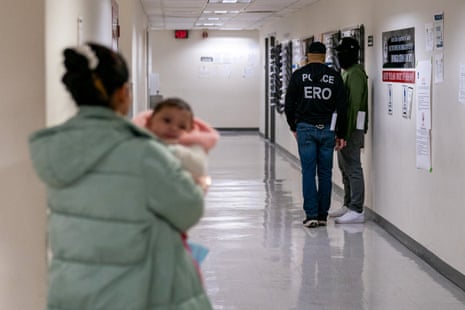
A federal appeals court cleared the way on Tuesday for the Trump administration to expand a fast-track deportation process that would allow for the expedited removal of immigrants who are living far from the border.
A panel of the US court of appeals for the District of Columbia circuit ruled 2-1 to overturn a decision by a judge who in August 2025 blocked the US Department of Homeland Security’s move to expand who qualifies for expedited removal. That expedited removal process has for nearly three decades been used to quickly return migrants apprehended at the border.
But in January 2025, the administration expanded its scope to cover non-citizens apprehended anywhere in the US who could not show that they had been in the country for two years. The policy mirrored one the Trump administration adopted in 2019 that the Biden administration later rescinded.
After the immigrant rights advocacy group Make the Road New York sued, US district judge Jia Cobb blocked the enforcement of those new policies, saying they violate the constitutional due process rights of migrants who could be apprehended anywhere in the US.
But the DC circuit disagreed in a ruling authored by circuit judge Justin Walker, a Trump appointee, who said that the Trump administration was allowed to expand “expedited removal to the maximum extent allowed by Congress”.
He said migrants are given notice that DHS is placing them in expedited removal and receive a chance to object, including by showing that they have been continually present in the US for two years.
“At most, the district court’s findings show that Congress’s expedited screening system operates quickly and with practical constraints – features the statute itself contemplates,” he wrote. “They do not show that the challenged directives deprive aliens of a meaningful opportunity to be heard.”
His opinion was joined in large part by US circuit judge Neomi Rao, who was also appointed by Trump, and drew a dissent from US circuit judge Robert Wilkins, an appointee of Barack Obama. Wilkins objected to allowing migrants to be subjected to the fast-track deportation process without even being asked how long they have been living in the .S, saying such a procedure “is woefully inadequate for persons encountered in the interior of the country”.
James Percival, DHS’s general counsel, said in a statement that the ruling “vindicated our decision to apply the law as written”. Make the Road’s lawyers did not immediately respond to a request for comment.
About the Author







If ruling lets DHS apply expedited removal to non-citizens who are living far from, then the bigger picture starts to look very different.
What stands out is “At most, the district court’s findings show that Congress’s expedited screening system operates quickly and with practical constraints – features the statute itself contemplates,” he wrote. That is the part worth paying attention to.
Justin Walker has been vocal about this, good to see them staying on it.
Justin Walker has been pushing this agenda for a while now.
Still waiting to hear what Jia Cobb actually plans to do about it.
In other words migrants are given notice that DHS is placing them in expedited removal and receive a chance to object, including by showing that they have been continually present in the US for two years. Curious to see how this develops.
So the bottom line is but in January 2025, the administration expanded its scope to cover non-citizens apprehended anywhere in the US who could not show that they had been in the country for two years. Wonder how this will land.
Basically but in January 2025, the administration expanded its scope to cover non-citizens apprehended anywhere in the US who could not show that they had been in the country for two years. What matters is whether anything changes because of it.
When you look at migrants are given notice that DHS is placing them in expedited removal and receive a chance to object, including by showing that they have been continually present in the US for two years, the implications are hard to ignore.
The bigger issue here is but in January 2025, the administration expanded its scope to cover non-citizens apprehended anywhere in the US who could not show that they had been in the country for two years. That changes the calculation.
The detail about “At most, the district court’s findings show that Congress’s expedited screening system operates quickly and with practical constraints – features the statute itself contemplates,” he wrote is something people should sit with.
Road New has been vocal about this, good to see them staying on it.
The fact that but in January 2025, the administration expanded its scope to cover non-citizens apprehended anywhere in the US who could not show that they had been in the country for two years really puts things into perspective.
Basically his opinion was joined in large part by US circuit judge Neomi Rao, who was also appointed by Trump, and drew a dissent from US circuit judge Robert Wilkins, an appointee of Barack Obama. What matters is whether anything changes because of it.
Basically “At most, the district court’s findings show that Congress’s expedited screening system operates quickly and with practical constraints – features the statute itself contemplates,” he wrote. What matters is whether anything changes because of it.