


Trump signs order attempting to override CDC vaccine schedule and break up MMR shots
President and RFK Jr, the health secretary, repeatedly referred to autism during signing, though studies show no link between it and vaccines
Donald Trump has signed an executive order with plans for sweeping changes to the childhood vaccination schedule that attempts to override the authority of the US Centers for Disease Control and Prevention (CDC).
It is an attempt to undergird the changes made earlier this year to CDC vaccination recommendations, which were halted by a federal judge. The CDC is the federal agency tasked with recommending vaccines, not the White House.
The order would also require that the measles, mumps and rubella vaccine be broken into three separate shots, once it becomes available in the US. And it would recommend that all shots be given at separate medical visits, a frequent point Trump has made despite the safety, ease and lower costs of giving vaccines together.
Only six of the 17 vaccines routinely recommended for all children in the US would continue to have full recommendations: measles, mumps, rubella (MMR), diphtheria, tetanus, pertussis (DTaP), polio, Hib, pneumococcal disease, HPV and varicella.
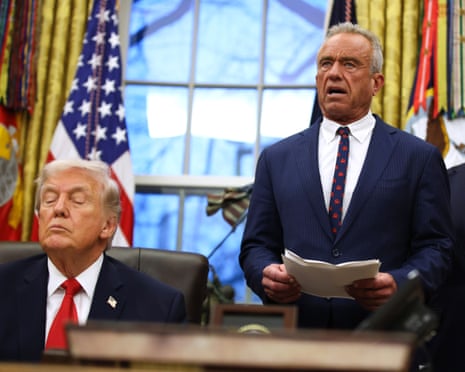
“Together, there could be a possibility they’re quite lethal,” Trump said of the MMR vaccine at the signing of the order on Monday.
Five other shots would be recommended only for those at high risk: monoclonal antibodies to protect against respiratory syncytial virus (RSV) as well as vaccines against hepatitis A, hepatitis B and meningococcal ACWY, which is currently recommended for teens and high-risk infants. Dengue and meningococcal B vaccines are also on this list, but dengue was already recommended only for those at risk and meningococcal B was shared clinical decision-making.
And six shots would be pushed to shared clinical decision-making: hepatitis A, hepatitis B, rotavirus, meningococcal disease, influenza and Covid-19.
This is a previously obscure category that means a provider would be required to weigh the risks and benefits, despite strong evidence for the safety and efficacy of these vaccines.
The executive order would also require the MMR vaccine to be broken into three separate shots, which is not currently possible in the US as there are no separately licensed vaccines for measles, mumps and rubella and the licensing process takes years.
The order also states that, “to the maximum extent feasible, all childhood immunizations should be administered at separate medical visits”. This would put a financial and logistical strain on families and medical providers by creating several additional visits.
The US attorney general would also be tasked with challenging state laws that conflict with the executive order. The US has no vaccination mandates. Shots that are required for school attendance are set at the state and local level.
Both Trump and Robert F Kennedy, the health secretary, made repeated mentions of autism throughout the order signing, emphasizing a scientifically unproven link between vaccines and the condition. Dozens of studies show no link between the two.
“Today we’re proud to officially announce the United States of America’s gold standard childhood vaccination recommendations. That has to do with many subjects including autism in particular,” Trump said at the beginning of the order signing.
“I’ve seen proof of it, where they have a vaccination where it looks like the size of a bottle of soda, poured into a little child’s body and bad things happen in too many cases,” Trump later said on breaking up each shot into an individual medical visit, before adding: “This is an explosion, it’s an epidemic,” in an apparent reference to autism.
Kennedy claimed at one point: “Something happened in the mid-90s that changed our children, and it has to be an environmental exposure.”
Executive orders are meant as guidance to federal agencies; they are not laws passed by Congress, and thus they have no legal effect on the public.
“This should have no direct operational effects,” says Dorit Reiss, a vaccines expert at UC Law San Francisco. Twenty-nine states and the District of Columbia have decoupled their vaccination requirements from the CDC, and insurance continues to cover the shots.
However, “Trump has influence,” Reiss said, and the order may intensify “political pressure on states” to change school requirements.
About the Author