


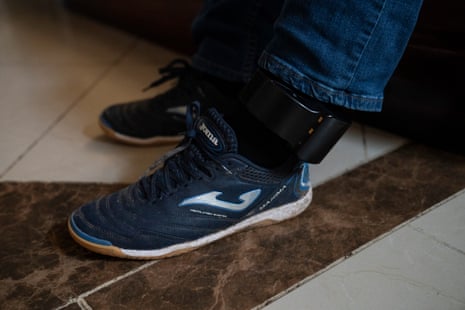

ICE is now tracking nearly 54,000 immigrants via ankle monitors
Shift in monitoring methods has led to revenue boost for Geo Group, a private prison firm, that also makes the device
The US is tracking nearly 54,000 immigrants through GPS-enabled ankle monitors as part of a US Immigration and Customs Enforcement (ICE) electronic surveillance program, according to private prison corporation The Geo Group. Early last year, just 17,000 immigrants were wearing the devices..
The Geo Group owns BI Inc, the company that runs ICE’s intensive supervision appearance program (ISAP), and reported the numbers in its earnings call on Thursday.
The overall number of immigrants enrolled in the surveillance program remained flat at about 184,000. Geo Group executives said that a large number of participants were shifted from less intensive forms of surveillance, such as phone check-ins, to ankle monitors.
The shift to ankle monitors, which the company pitches as a “high-security level of monitoring”, has increased revenues for Geo Group . Ankle monitors cost ICE more than most of the other surveillance technologies administered by BI Inc. The company charges ICE a little more than $2 a day per monitor, while the SmartLink app – a facial recognition and location tracking smart phone app – costs about $0.96 for each immigrant enrolled, according to publicly available ICE statistics. At last count, more than 127,000 immigrants are required to check in using SmartLink.
“If this trend continues, the technology and case management mix shift will continue to increase revenues and earnings generated under the ISAP contract even if overall participation counts remain relatively stable,” said George Zoley, Geo Group chairman and CEO, on an earnings call on Thursday.
ICE directed agents in June 2025 to move more immigrants enrolled in ISAP to the ankle monitor program, according to a memo obtained by the Washington Post.
In a new class action lawsuit filed against ICE in June, immigration advocacy groups allege this “ankle monitors for all” policy “imposes continuous, real-time GPS monitoring without individualized justifications”. Individuals are being subjected to constant surveillance “without meaningful review, explanation, or opportunity to challenge these conditions”, the statement announcing the lawsuit read. That includes pregnant women, who the Guardian first reported were being fitted with smart watches.
“ICE has offered no justification for their ‘ankle monitors for all’ policy, but it serves their interest in making daily life harder for immigrants, while also increasing profits for their friends in the private prison industry,” said Evan Benz, managing attorney at the Amica Center for Immigrant Rights, in a statement announcing the lawsuit.
The Guardian has reached out to the Department of Homeland Security.
Anticipating an increase in reliance on ankle monitors, Geo Groupbegan investing in building out its inventory of the GPS devices at the start of 2025. At the time, the company said it was investing $16m into manufacturing enough ankle monitors to “be in a position to scale up the federal government’s utilization of ISAP by several hundreds of thousands to upwards of several millions of participants as required”.
While the company’s predictions of an increase in the use of ankle monitors to track immigrants has started to pan out, investors on Thursday expressed concern about the lack of growth in overall numbers of immigrants being monitored through ISAP. Previously, Geo Group executives said they expected the Trump administration’s immigration agenda would result in a surge in the number of immigrants monitored through ISAP, allowing them to surpass the previous peak of 370,000 under the Biden administration. The company said they thought there would be enough demand from the US government to expand the surveillance program to monitor more than 400,000 immigrants.
Without going into specifics, Zoley said he was optimistic that recent shifts in policy could increase the number of people who “would be subject to immigration enforcement … So at a later point, maybe next year, we could see ISAP increase dramatically.” The Trump administration has most recently revoked Temporary Protected Status for Haitians, potentially subjecting hundreds of thousands of people in the US to detention or deportation.
Company executives have said in the past that they expect the numbers of immigrants enrolled in ISAP to grow once the government runs out of capacity in detention centers.
ISAP was first introduced as an alternative to detention and has been operated by BI Inc since 2004. The program relies on several forms of monitoring in addition to the GPS-ankle monitors, including smart watches that provide real-time location tracking, and a smart phone app.
People in the program have reported that the ankle monitors, designed and produced by BI, can overheat, shock them or have been put on too tightly and that there’s little government oversight over the program.
About the Author